
[favorite_button]
Autonomous driving is becoming a reality
Summary
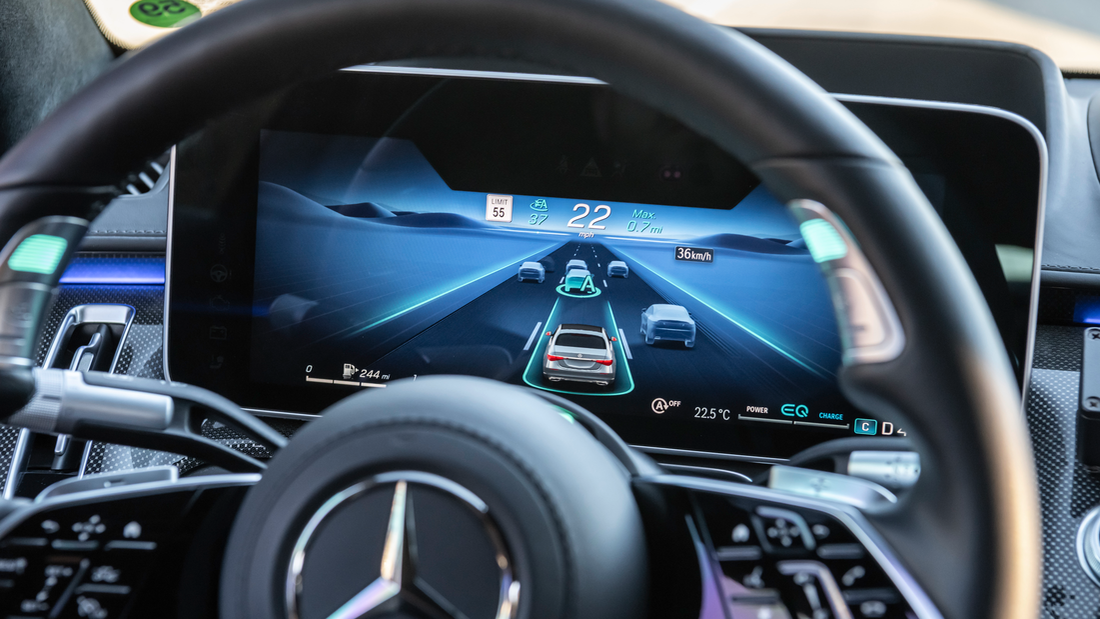
Mercedes is the first car manufacturer in the world to offer an approved Level 3 system – and is thus also liable for accidents involving the virtual driver. By the end of 2022, the Level 3 Drive Pilot is to be allowed on the road in California and Nevada.
At Level 3: VM is responsible and in liability
insight: Autonomous driving is defined in 5 Levels
Like what you see?
Then log-in to unlock all the content or become a member of Carmunication today!
Mercedes is the first car manufacturer in the world to offer an approved Level 3 system – and is thus also liable for accidents involving the virtual driver. By the end of 2022, the Level 3 Drive Pilot is to be allowed on the road in California and Nevada.
At Level 3: VM is responsible and in liability
insight: Autonomous driving is defined in 5 Levels
Details
At Level 3: VM is responsible and in liability
By activating the Level 3 Drive Pilot, the driver relinquishes responsibility for his vehicle to his vehicle. And with it, liability. This is transferred to the manufacturer. And it is precisely for this reason that the manufacturer has defined the usage window for the Level 3 system extremely narrowly: For the time being, it works exclusively on motorways, does not change lanes, is only active up to 60 km/h, only during daylight, not in tunnels or construction sites and only at temperatures above three degrees Celsius.
The advantages of autonomous driving
For society, traffic will run more smoothly and goods can be transported in a more rational and environmentally friendly way. Depending on the degree of automation, the number of accidents will also be further reduced, because human error is the cause of 90 percent of all crashes. A forecast by experts at the Fraunhofer Institute says that by 2050 half and by 2060 all motor vehicles could be driving autonomously.

Autonomous driving – Level 1 to 5
Assisted, semi-automated, highly automated, fully automated, autonomous: these are the five levels of autonomous mobility:
Level 1 – Assisted driving: At this level, the driver is in full control of his vehicle, keeps a constant eye on the traffic and bears sole responsibility for  any damage or failure to comply with traffic regulations. Assistance systems such as cruise control or automatic lane departure warning assist with some driving tasks.
Level 2 – Partially automated driving: The driver still bears sole responsibility for the vehicle and driving behaviour. However, the vehicle is able to perform some tasks temporarily without the driver’s intervention. For example, a partially automated vehicle at level 2 can maintain the lane, brake and accelerate on the motorway. The overtaking assistant or automatic parking are also level 2 functions.
Level 3 – Highly automated driving: From now on, the driver is allowed to temporarily turn away from traffic because the vehicle participates in road traffic independently in predefined use cases. The system specifies when the driver must spontaneously take over and prompts him to do so. In level 3 driving, the driver is only liable if he or she does not comply with the request.
Level 4 – Fully automated driving: On certain routes, driving is completely taken over, and drivers become passengers. The vehicle is even allowed to move without occupants. The passenger is allowed to sleep, read the newspaper, make a phone call or watch a film. The system is able to recognise limits and dangers early enough to ensure safety in accordance with the rules. Experts expect that so-called Level 4 vehicles, whose functions the driver no longer has to monitor himself, will be rolling along our roads before the end of this decade.
The approval of the Bundestag and Bundesrat, according to which autonomous vehicles in Germany could probably take part in public road traffic without a physically present driver in the course of this year, is, however, only to apply in defined and pre-approved operating areas for the time being.
Level 5 – Autonomous driving: The fifth, final level describes truly autonomous driving. In this world of autonomous driving, there are only passengers. Vehicles are completely controlled by the system, which performs all the necessary tasks completely autonomously. In complex situations – for example at a junction or a pedestrian crossing – the autonomous vehicle recognises how to act. In the event of accidents, passengers will no longer be liable; liability will then lie with manufacturers, operators or insurers.

Autonomous driving – the technology
To make autonomous driving possible, a number of technical challenges have to be overcome.

Video cameras provide real images of the surroundings with the road, traffic signs and other road users. They also help the autonomous system to correctly estimate the distance to objects. Autonomous vehicles often have five cameras, one in the front, one in the rear, one on each side and one on the roof. In addition, there is a video camera to monitor the driver. Depending on the autonomy level, the driver may not be allowed to sleep while driving, for example.
Radar sensors on the car measure the distance to other road users and objects. Low- and high-range sensors calculate the different distances. That is why a car needs several of them – in different places. Today, the beeping ultrasonic sensors are already well known as parking aids.
Lidar sensors (Light Detection and Ranging) scan the road ahead. The optical measuring system fires laser beams that are invisible to humans and calculates the path of the reflected back beams from an obstacle. Lidar sensors use laser beams for measurement instead of radio waves, as with radar. Their advantage: the long range. Unlike ultrasound, lidar sensors “see” up to 200 metres away – even at night. Lidar sensors complement radar sensors.
With a GPS system, the car is precisely located. The system always knows where it is – not only on which road, but also in which lane. This is crucial for turning vehicles. For optimal routing, road maps accurate to within two centimetres and a fast navigation system are also necessary.
Sources

Written by Carmupedia Editorial Office
You might also be interested in







Please rate this article
Let us know if you like this article by leaving a rating. Don't worry, it's super easy.
Placeholder
Manage my notifications
Your member panel
From here you have full control over your profile
My bookmarks
[user_favorites]
[clear_favorites_button]
Are you missing something here?
0 Comments