
[favorite_button]
Big Data in the developement of connected cars
Summary
Data management in the development of autonomous driving functions
A distinction must be made between the collection of data during the operation of the vehicle, i.e. regularly purchased and registered vehicles, and development vehicles.
“Standard data”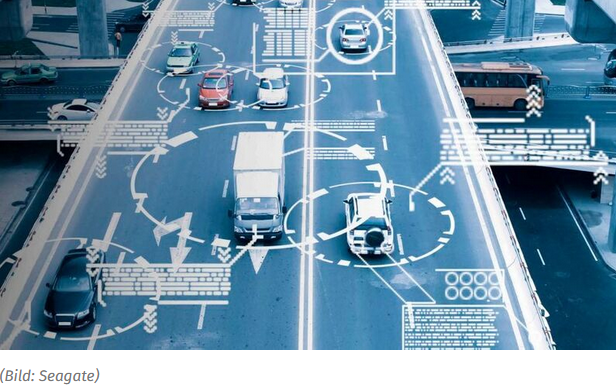
In general, the type and amount of data collected varies from OEMOEM – Original Equipment Manufacturer. More to OEMOEM – Original Equipment Manufacturer. More. In recent years, most OEMs have started to collect basic values such as location, odometer, speed, RPM, diagnostic trouble codes (DTCs), and so on. This currently collects around 50 megabytes of data per month per vehicle from “standard data”.
Development data
One of the biggest challenges in the development of autonomous vehicles is data collection and data management. Today’s test prototypes typically house between four and six cameras and one to five LiDAR sensors, which continuously produce complex data sets. An average Level 3 test vehicle produces about 150 TB of data per day (the equivalent of 38,400 two-hour HD movies or 30 million songs). A fleet of 10 to 20 research vehicles collects 1.5 Peta Byte of data per day.
It would take more than 150 days to transfer it via a 5G5G is short for “fifth generation”: 5G is set to be as much as 100 times faster than 4G. 5G networks will have greater bandwidth, giving faster download speeds. 5G is the fifth generation technology standard for cellular networks. More network to the research labs. A real hurdle for the...
Like what you see?
Then log-in to unlock all the content or become a member of Carmunication today!
Data management in the development of autonomous driving functions
A distinction must be made between the collection of data during the operation of the vehicle, i.e. regularly purchased and registered vehicles, and development vehicles.
“Standard data”
In general, the type and amount of data collected varies from OEMOEM – Original Equipment Manufacturer. More to OEMOEM – Original Equipment Manufacturer. More. In recent years, most OEMs have started to collect basic values such as location, odometer, speed, RPM, diagnostic trouble codes (DTCs), and so on. This currently collects around 50 megabytes of data per month per vehicle from “standard data”.
Development data
One of the biggest challenges in the development of autonomous vehicles is data collection and data management. Today’s test prototypes typically house between four and six cameras and one to five LiDAR sensors, which continuously produce complex data sets. An average Level 3 test vehicle produces about 150 TB of data per day (the equivalent of 38,400 two-hour HD movies or 30 million songs). A fleet of 10 to 20 research vehicles collects 1.5 Peta Byte of data per day.
It would take more than 150 days to transfer it via a 5G5G is short for “fifth generation”: 5G is set to be as much as 100 times faster than 4G. 5G networks will have greater bandwidth, giving faster download speeds. 5G is the fifth generation technology standard for cellular networks. More network to the research labs. A real hurdle for the development of production-ready technologies for autonomous driving. Typical validation programmes for AV neural networks require a minimum of 20 petabytes of training data and about 70% of development time costs managing, labelling and processing that data, and transforming it into something to use just to train the neural networks.
The solution: physical data transfer for fast availability
In concrete terms, this means that all camera and sensor data are stored on a drive in the boot of the research vehicle. After the test drive, the portable drive is moved to where the data is needed next for further analysis: for example, on the company’s own private cloud server or at a storage-as-a-service cloud provider.
Details
Sources
Click to rate this post!
[Total: 1 Average: 1]

Written by Carmupedia Editorial Office
You might also be interested in








2 Comments
Submit a Comment
Please rate this article
Let us know if you like this article by leaving a rating. Don't worry, it's super easy.
Click to rate this post!
[Total: 1 Average: 1]
Placeholder
Manage my notifications
Your member panel
From here you have full control over your profile
My bookmarks
[user_favorites]
[clear_favorites_button]
Are you missing something here?
the sources of the article are not mentioned
Dear Walter
Thank you very much for your feedback. This article should explain the problems with the development of current vehicles. This was detailed in the title of the summary. To this end, an attempt was made to show generically the quantity structure of the data and the problems of dealing with it. In the details, you will find an overview of the latest methodologies.
Sorry for the confusion, in response to your comment, we have adjusted the title accordingly.
We look forward to any feedback and dialogue with our members.
Any feedback is always very welcome.
Thank you very much.
Your Carmupedia Editorial Office